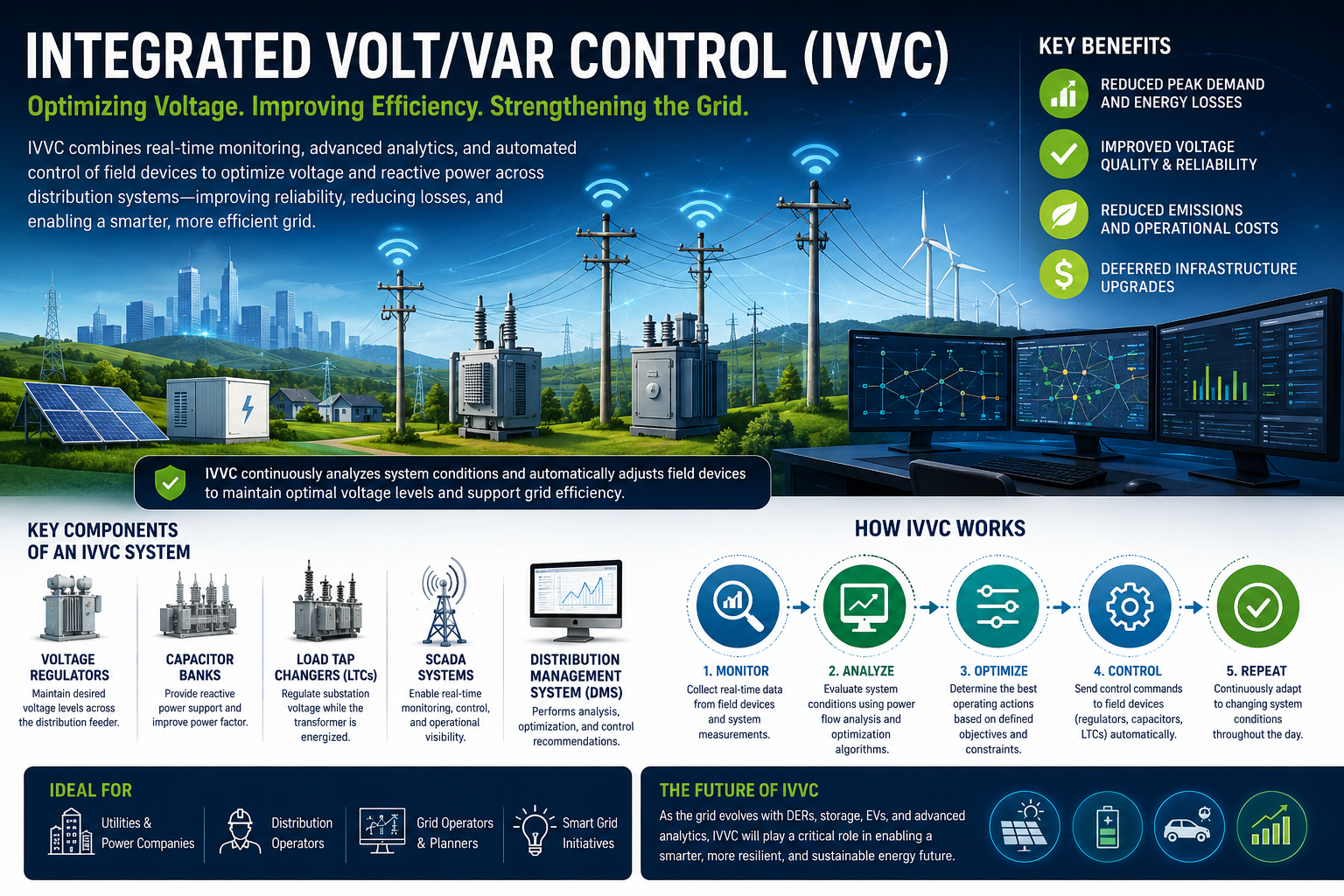

Advanced Volt/VAR Optimization (VVO) and Integrated Volt/VAR Control (IVVC) systems have become important components of modern utility grid modernization programs. These technologies help utilities improve voltage performance, reduce system losses, optimize reactive power flow, and support energy efficiency objectives.
While the potential benefits are significant, successful implementation requires much more than software installation and device deployment. Experience across multiple utility environments has shown that organizational readiness, model accuracy, communications infrastructure, operational processes, and long-term support structures often determine the success of an IVVC program.
1. Accurate Network Models Are Critical
One of the most important lessons learned is that optimization systems are only as effective as the network models that support them.
Advanced Distribution Management Systems (ADMS) rely on accurate feeder connectivity, switching status, equipment ratings, and real-time telemetry to perform distribution power flow calculations.
Common challenges include:
- Outdated GIS information
- Incorrect switching status
- Missing field equipment data
- Model synchronization delays
- Incomplete device representation
Even small modeling errors can significantly impact optimization results and operator confidence.
Utilities should invest heavily in model validation and establish strong processes for maintaining model accuracy over time.
2. Communications Infrastructure Drives Performance
Many utilities initially focus on field devices while underestimating communications requirements.
Successful IVVC operation depends on reliable communications between:
- Capacitor bank controllers
- Voltage regulators
- Substation equipment
- Sensors
- SCADA systems
- Distribution Management Systems
Common issues include:
- Cellular coverage limitations
- Modem failures
- Antenna placement problems
- Data latency
- Device time synchronization issues
A communication strategy should be developed early in the project and continuously monitored after deployment.
3. Device Data Quality Matters
Optimization algorithms depend on accurate field measurements.
Utilities should verify:
- Voltage measurements
- Current measurements
- Power factor calculations
- Tap position indication
- Capacitor status indication
Poor-quality field data often leads to unnecessary troubleshooting and reduced optimization performance.
Validation processes should be established before large-scale deployment.
4. Commissioning Is More Important Than Installation
Installing equipment does not mean the system is ready for operation.
Each circuit should undergo detailed commissioning to verify:
- Device communications
- Control functionality
- SCADA integration
- Model representation
- Power flow accuracy
- Operational readiness
Utilities that invest in structured commissioning processes typically experience fewer operational issues after deployment.
5. Operator Training Cannot Be Overlooked
Grid operators play a critical role in successful IVVC operation.
Operators should understand:
- How optimization systems function
- How switching impacts optimization
- How to recognize model issues
- How to respond to alarms
- How to identify communication failures
Training should focus on practical operational scenarios rather than software functionality alone.
6. Switching Operations Significantly Affect Optimization
One of the most common operational challenges involves feeder switching.
Distribution power flow calculations rely on accurate system topology.
When switching activities are not modeled correctly:
- Voltage calculations become inaccurate
- Optimization decisions degrade
- Circuit performance suffers
- Operator confidence decreases
Utilities should establish clear procedures linking switching operations and model updates.
7. Performance Tracking Must Be Built from Day One
Many projects focus heavily on deployment but overlook benefit measurement.
Successful programs establish baseline metrics before deployment, including:
- Voltage profiles
- Power factor performance
- Energy consumption
- System losses
- Demand levels
Tracking tools should provide visibility into both operational performance and business benefits.
8. Deployment Is Only the Beginning
Many organizations underestimate the amount of post-deployment work required.
Ongoing activities often include:
- Firmware updates
- Communication troubleshooting
- Device replacement
- Model corrections
- Configuration changes
- Performance analysis
Long-term support plans should be established before deployment begins.
9. Organizational Alignment Is Essential
Volt/VAR Optimization projects involve many groups across a utility organization.
Common stakeholders include:
- Operations
- Engineering
- Telecommunications
- SCADA support
- GIS teams
- Asset management
- Construction and maintenance
- Information technology
Clear ownership, support processes, and communication channels significantly improve deployment success.
Final Thoughts
Volt/VAR Optimization remains one of the most effective technologies available for improving distribution system efficiency and supporting grid modernization objectives.
However, successful implementation requires more than advanced software and field devices. Long-term success depends on accurate models, reliable communications, quality data, effective processes, operator training, and organizational commitment.
Utilities that address these factors early are far more likely to achieve sustainable operational and financial benefits from their optimization programs.